
Boosting Success with Prosocial Ed
Supporting all your students in reaching academic goals and standards is a huge task. When students develop stronger prosocial behaviors, they’re better positioned for academic success. Prosocial Ed strategies integrate seamlessly into existing teaching practices and actually make your job easier.
What is Prosocial Ed?The Impact of Prosocial Education
- Increase in student prosocial behavior.
- Improved teacher-student relationships.
- Instructional time gains. Teachers using Prosocial Ed strategies have reported gaining an average of 30 minutes per week per class, primarily due to less disruptive student behavior.
- Increased teacher self-efficacy and job satisfaction, and decreased burnout. How confident teachers’ feel in their ability to teach predicts burnout, job satisfaction and retention. When teachers feel more confident, they use better teaching and classroom management strategies.
- Increased student engagement and learning, including higher test scores compared to control-group students. This is especially noteworthy because the focus is on improving prosocial behavior among students rather than academic content. It is an “indirect” effect of students treating one another and their teacher more respectfully.
- Improved school climate. The primary driver of climate in schools is personal relationships. Students’ prosocial behavior toward each other and positive teacher-student relationships are the foundation.
Our Reach
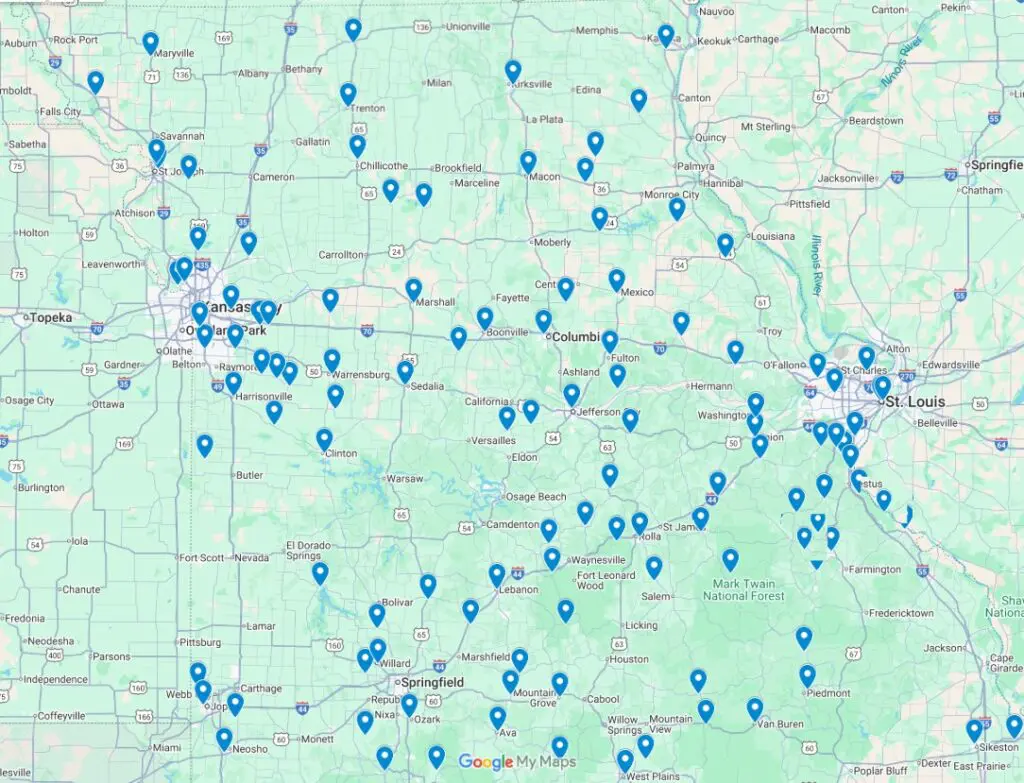
Teachers from 120+ schools participated from Missouri, Arkansas, Kansas, and Texas.
This map shows the location of participants in Missouri.
Prosocial Ed Project Results
PAL Classrooms 1.0
Fifty-four math and science (5th grade) teachers from 35 schools participated in PD sessions, a book study, and in‑class coaching across a school year. The project started with in‑person PD, but changed to virtual due to COVID.
Teachers learned how to teach in a technology‑rich environment and use student‑centered team learning, while also supporting students’ prosocial behavior so that teams function more harmoniously.This project was funded by the U.S. Dept. of Education (EIR).
Results indicate that:
- Teachers improved in emotional support [ES = 0.64] as measured by observation, compared to a control group.
- Teachers improved in their use of praising prosocial behavior [ES = 0.30] and more effective discipline (inductive discipline) [ES = 0.29] as measured by student perception.
- Students reported that their classmates [ES = 0.31] and their selves [ES = 0.23] were more prosocial.
- Students reported greater engagement [ES = 0.22].
ECHO: Prosocial and Positive School Climate – Middle School
Using the ECHO telementoring model, 64 teachers in cohorts attended monthly virtual PD sessions for one year. Sessions were designed to build teachers’ capacity to promote prosocial behavior between students. Sessions included a brief didactic lesson on cutting‑edge research presented by academic experts. This was followed by teachers presenting a case study of real challenges in their classrooms with the cohort of colleagues recommending solutions. This project was funded by the U.S. Dept. of Education (IES).
Participants compared to control group:
- Teacher self‑efficacy increased [ES = 0.80]
- Teachers felt less burnout [ES = .59]
- Teachers felt more job satisfaction [ES = .40]
- Students felt greater belonging [ES = .20]
Math, Prosocial Education, and Equity
Using a combination of in-person and virtual professional development, 120 middle school math teachers in Texas learned the four pillar strategies of Prosocial Ed. Most (72%) reported that their instructional time increased (with an average of 30 minutes per week per class), primarily due to less time spent on correcting disruptive behavior.
This project was funded by the U.S. Dept. of Education (SEED). The project was terminated just prior to collecting outcome data, by the Trump administration. Thus, no further outcome results are available.
vSchool
This project developed and validated a school-friendly, videogame-based assessment of prosocial behavior, for schools to use to evaluate interventions designed to help students develop social-emotional skills. This project was funded by the U.S. Dept. of Education (IES).
It was developed by a transdisciplinary team of experts on prosocial development, psychometrics, the use of technology to measure social-emotional skills, and online game development.
The Leader in Me (LiM)
The Leader in Me (LiM) is a universal program facilitated by teachers and staff that emphasizes learning to live by principles in Covey’s “7 Habits of Highly Effective People.” Students are given meaningful leadership roles in the school and helped to grow their strengths. Our lab conducted a mixed method study: (1) A case study of 4 diverse elementary schools, and (2) A matched comparison (using propensity score matching) of 117 LiM and 348 non‑LiM schools using secondary state‑wide data.
We found that:
- Both students and teachers became more prosocial
- Teachers were re‑energized about teaching
- Students became more motivated
- Their attendance and achievement was modestly higher
- Discipline rates were lower after their schools implemented LiM
We are currently conducting a follow‑on quasi‑experimental study of LiM.
Enroll in Free Programs Now
We currently have one project taking new enrollment for AY2025-2026 and AY2026-2027
Prosocial and Active Learning (PAL) 2.0 Classrooms This project seeks to replicate the success of PAL 1.0, but in middle schools with teachers of any subject, across the United States.
The project helps educators learn Prosocial Ed strategies. A minimum of two teachers and one administrator from each school enroll together.